BANT Lead Qualification for Service Businesses: Prioritize Callbacks and Close More Jobs
Learn how to apply BANT lead qualification to your service business. Translate Budget, Authority, Need, and Timeline into contractor language and build a ranked callback queue that wins high-value jobs first.
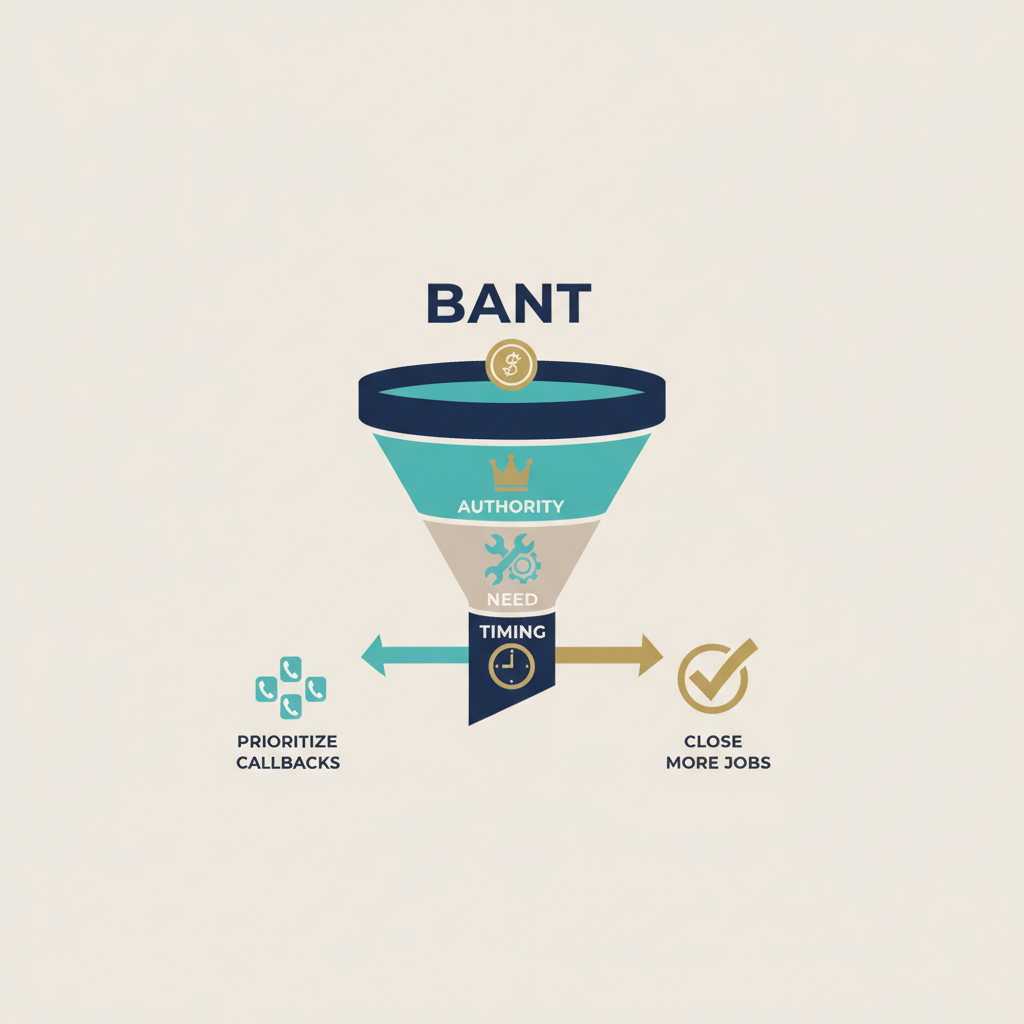
You're Calling Leads Back in the Wrong Order
Ten form submissions came in overnight. One is a $14,000 reroof with insurance already approved. Nine are early-stage price checks. You call them in arrival order. By the time you reach the insurance job, three hours have passed, and the homeowner has already booked a competitor who called back within thirty minutes.
That scenario plays out every day in service businesses that treat the callback queue like a to-do list instead of a triage problem. The leads that arrived first are not the leads that deserve the most urgency. Without a qualification system, you have no way to know which is which. You burn drive time running free estimates for buyers who were never serious, while a high-probability job goes cold in your inbox. Research on lead response time in the home services field consistently shows that contact rates fall sharply after the first hour. The MIT Lead Response Management study is widely cited in this context; verify the specific figures independently before relying on them, but the directional finding is well-documented. A $12,000–$15,000 job that went cold while you were driving to a free estimate is not a bad-luck problem. It is a prioritization problem, and prioritization problems have frameworks.
What Is BANT Lead Qualification? (The 60-Second Version)
BANT lead qualification is a four-part framework for evaluating whether an inbound lead is worth pursuing now.
- B – Budget: Can they pay for the work?
- A – Authority: Are they the decision-maker?
- N – Need: Do they have a real, defined problem?
- T – Timeline: When do they need the work done?
The framework originated in enterprise sales. IBM developed it in the 1960s to help sales teams allocate time across large prospect lists. The core logic is simple: not every lead deserves the same level of immediate effort, and four structured questions give you enough data to rank them in under a minute.
That logic applies to a plumber in Phoenix exactly as it applies to a software rep in San Francisco. The framework is not about sales sophistication. It is about prioritization. A roofing company fielding forty inbound leads a week and a SaaS company managing a CRM pipeline are solving the same problem: figure out which opportunities are real, and reach those people first. BANT lead qualification gives both of them the same four-part answer.
Translating BANT Into Contractor Language
The reason most home-service businesses never adopt a qualification framework is not resistance. It is translation. "What is your budget for this initiative?" sounds reasonable in a boardroom and bizarre on a porch in Baton Rouge. The skill is not learning BANT. The skill is rephrasing each dimension into a question that sounds like a knowledgeable contractor asking something sensible.
Here are the BANT questions for home services, dimension by dimension.
Budget: "Is this insurance, financed, or out of pocket?"
The enterprise version asks for a dollar figure. Homeowners rarely know their number before they see a scope of work, so pressing for one early creates friction and sounds presumptuous. The contractor reframe skips the dollar figure and asks about the payment source instead. An insurance claim tells you a budget has already been established and a third party has approved the spend. Financing through a program like GreenSky or a regional lender tells you the homeowner is committed enough to research options. Out of pocket tells you price sensitivity may be a real factor and the estimate conversation will require more time.
Authority: "Homeowner or tenant?"
The enterprise version asks whether the contact can sign a contract. The contractor reframe asks the same question in plain residential language. Homeowner vs. tenant is one of the most consequential qualifiers in home services, and it is frequently skipped. A tenant cannot authorize most work on the property. They cannot sign a contract, approve a scope change, or release a deposit. If you complete a site visit and discover the person who called is a renter, the job cannot proceed until you reach a landlord who is often unreachable, sometimes out of state, and occasionally uninterested. That is a half-day site visit, zero revenue, and a slot in the queue that could have gone to a confirmed homeowner. Ask this question first on every call.
Need: "Repair, replace, or quote-shopping?"
The enterprise version asks whether the prospect has a defined problem. The contractor reframe surfaces both the scope and the buying intent simultaneously. A homeowner who says "replace" has already moved past the diagnosis stage. They know the asset is at end of life and they need a contractor, not an opinion. A homeowner who says "repair" needs scoping before pricing. A homeowner who says "quote-shopping" is likely in early research mode, and while that lead is still worth working, it belongs lower in the same-day callback queue than a confirmed project.
Timeline: "Emergency, this week, or someday?"
The enterprise version asks for a target decision date. The contractor version asks for operational urgency. Water coming through a ceiling, no heat in a Minnesota January, or a gas smell does not have a decision date. It has a right-now date. That lead overrides everything else in the queue. "This week" is a warm lead that wants to move. "Someday" is a nurture lead that can receive a follow-up sequence instead of a same-day callback.
| BANT Letter | What Enterprise Sales Asks | What a Contractor Asks | What the Answer Tells You |
|---|---|---|---|
| B – Budget | "What budget has been allocated for this project?" | "Is this going through insurance, or are you paying out of pocket?" | Insurance = pre-approved spend, high close probability. Out of pocket = price sensitivity likely; factor in estimate time. |
| A – Authority | "Are you the decision-maker on this purchase?" | "Are you the homeowner, or is this a rental property?" | Tenant = cannot authorize work; do not dispatch until you reach the landlord. Homeowner = can sign and proceed. |
| N – Need | "What problem are you trying to solve?" | "Are you looking at a repair, a full replacement, or still getting a few quotes?" | Reroof vs. repair vs. tarping scope determines estimate complexity. Quote-shopping moves lower in same-day queue. |
| T – Timeline | "What is your target decision date?" | "Is this urgent — something happening right now — or a project you're planning out?" | No-heat call or active leak = emergency override, call immediately. Planned project = schedule within 24 hours. Vague timeline = send qualification text before dispatching. |
Qualify at First Contact, Not at Callback
You don't need any software to do this. The four questions above can be captured in a single text message, a form auto-reply, or a two-minute intake call. The goal is to have the BANT data in hand before you pick up the phone for the callback, not after.
Script 2: Live intake script for an office manager (phone or text)
Four questions, in this order:
- Authority: "Are you the homeowner, or is this a rental?"
- Timeline: "Is this urgent — like it's happening right now — or more of a project you're planning?"
- Budget: "Have you already filed with insurance, or would you be paying out of pocket?"
- Need: "What exactly is going on — can you describe what you're seeing?"
How to Score Leads and Build Your Callback Queue
Assign one point for each BANT dimension answered positively. Maximum score: 4. That number tells you where the lead goes in your callback queue. Emergency status is an automatic override and supersedes all other scores.
Here is what a ranked callback queue looks like using this model:
- Sarah M. — Score: 5 (emergency override): No heat, homeowner, called this morning. Call immediately.
- James R. — Score: 4/4: Insurance approved, owner, full reroof confirmed, needs work this week. Call within the hour.
- Tom B. — Score: 2/4: Out of pocket, owner, repair, "sometime next month." Call end of day.
- Unknown — Score: 1/4: Voicemail only, no intake questions answered. Send qualification text first.
That queue took under two minutes to build and guarantees that James R. does not go cold while you're driving to Tom B.'s house.
One practical note on weighting: for a plumber, Timeline carries more operational weight than Budget because emergency calls drive the majority of revenue. For a roofer, Authority matters most because insurance jobs stall immediately on the homeowner vs. tenant question. The equal-weight 4-point model is the right starting point for most service businesses. Adjust weights once you have enough closed-job data to see your own patterns.
What Happens When You Automate BANT Qualification
The manual method above works. The automated version means your queue is already ranked before you pour your first coffee.
Here is the difference in practice:
Arbitro's AI intake captures qualification data from the first message your lead sends, so your callback queue is already ranked before you pick up the phone. Every lead that comes in through your web form, SMS channel, or missed call gets processed through the same four-dimension framework automatically, and the output is a structured record instead of a voicemail.
You already have the manual method. Arbitro is the accelerant.
See how Arbitro qualifies leads before you call
Your callback queue, already ranked before you pick up the phone.